What happened
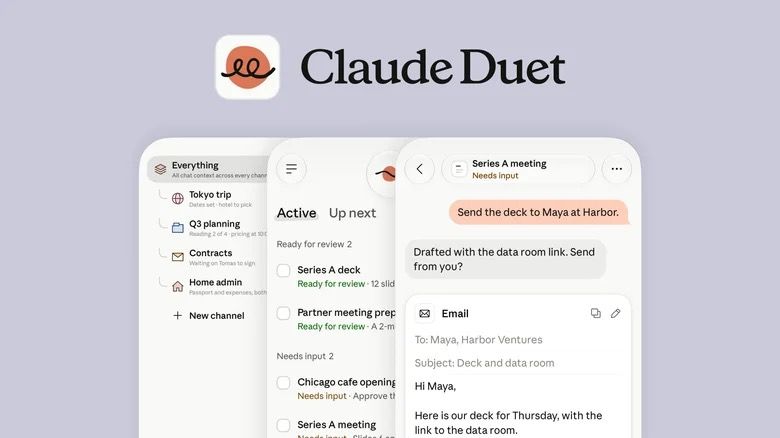
On 21 October 2026, Anthropic launched Claude Duet as a research preview. It is a separate app — on your phone, and at claude.ai on a computer — built on Claude Opus 5.5, and aimed at professionals and small-business owners who have too much to track. The difference from the Claude you know: Duet starts the conversation. It does not wait for you to open a chat.
Who can get it, and this is the part to read first: only Claude Pro and Max subscribers in the United States, and only through a waitlist. The waitlist email has to match your Claude account. Team and Enterprise plans are not included. If you are outside the US, this is a read-and-wait item for now.
On price: there is no extra charge during the preview, but Duet shares your plan's usage limits, and its background checks count against them.
What's actually new
Compared with a chat assistant, three things change.
It reaches out first
A short morning brief of what matters in your connected apps. Then it checks them every few hours and messages you only when something needs attention. You can set what you want to hear about and how often.
It works in the cloud, with its own browser
Duet runs in its own virtual machine and keeps working after you turn off your computer or lock your phone. It connects to more than 6,000 connectors — Gmail, Google Calendar, Google Drive, Slack, QuickBooks, HubSpot, DocuSign and Calendly among them — and uses its cloud browser for sites without one.
It asks before the things that cannot be undone
It asks before sending a message or email, paying, signing a document or deleting anything. It will not buy or sell securities or move money between accounts, even if you approve. It does not see your passwords, and it keeps everything in one ongoing thread that inherits the memory, skills and connected apps from your Claude account.
The pattern under all three: the agent finally works on your calendar, not yours on its. Whether that helps depends on how much of your day is hidden in inboxes.
How it helps a small or mid-sized business
Duet is for the owner's own pile. These are the chores it fits.
- The 7:40 brief. Instead of opening four apps, one message: two customer emails need a reply, one quote expires today, one invoice is a month late.
- Overdue invoices. It spots the invoices in QuickBooks past 30 days and prepares a reminder for each — and waits for your approval before anything is sent.
- A deal that went quiet. A deal in HubSpot nobody has touched for ten days, with a follow-up drafted.
- A contract waiting for you. A DocuSign document that has been sitting for three days, surfaced before the client asks.
- Calendar clashes. Two bookings on the same Thursday afternoon, caught the day before.
All of these are about you not missing something. None of them is about talking to a customer.
What it doesn't change
Anthropic is unusually direct about the limits. Read them.
It may misjudge what is urgent
Anthropic says Duet can misread a thread or get urgency wrong, and an urgent message that arrives between checks can be missed. A check every few hours is not a pager.
You cannot watch or take over its browser yet
When it works on a site, you see the result, not the screen. Some connectors, Slack among them, have limits inside Duet, and Microsoft 365 is not available yet — a gap for many offices.
It cannot call or text anyone
It has no phone line and no text messages, and it is weaker at personal errands like booking tickets. It is built for your own work, not for reaching your customers.
Background checks use your allowance
Large tasks use more, and the morning brief counts. Approved users get a one-time usage reset valid until 30 November 2026, per one report.
What to do this month
Whether or not you can get in, this costs nothing and makes any agent work better.
- Join the waitlist if you are eligible — US, Claude Pro or Max, matching email.
- Write the five things you check every morning. That list is the brief you will want, and it works as a manual routine today.
- Decide what it may never send without you. Quotes, refunds, anything that mentions a price.
- Pick your connectors by risk. Calendar and invoices first; the inbox you reply to customers from last.
- Judge it on missed things, not on volume. Count what it caught that you would have missed.
If you are outside the US: do not wait around for it. The preparation above works with any assistant you use today.
How to read the next announcement
There will be another launch within months. Four questions get you to the answer that matters faster than any coverage of it.
- Can I actually get it, and on which plan? A large share of every launch is either unreleased, sitting behind a tier above the one you pay for, or closed in your country.
- What can it do that the last one couldn't? Test scores almost never change your week. “Keeps working when your computer is off” does.
- How fast, and how much? Those two numbers alone decide whether it can go anywhere near a customer, or only near your back office.
- What did they not say? The limitations are always the shortest section in the announcement and the most useful one in it.
Most AI announcements change nothing for a small business in the month they land. That is the normal outcome, not cynicism. The ones worth your afternoon are the ones that take a specific job off your desk — and you will usually recognise them by how boring that job is.
Where AssistantLabs fits
Duet watches your own apps and keeps you from missing things. It cannot call or text, so it is not the one who answers your customers.
These agents work for you. Your customers talk to someone else.
An agent like this sits on the owner's side: your inbox, your calendar, your spreadsheets. When a customer writes on WhatsApp at 22:40 and asks whether the item is in stock, none of them is documented as the one answering. That is sensible — whatever answers customers in your name should not also hold the keys to everything you own.
What an agent that talks to customers needs instead
- To know only your business — catalog, prices, FAQ, opening hours. Not your inbox, not your accounts.
- To work where customers already write — WhatsApp, Instagram, email, website chat — in their language.
- To hand over to a person when it should, and record what is still open.
- To start muted and only answer once you have seen how it handles real questions.
They complement, not compete. You can connect your AssistantLabs workspace to Claude or ChatGPT and ask about your customers' conversations. What we have not confirmed: whether Duet or Dots can use a connection like that at launch — check before you rely on it.
If you want an agent that answers customers on AssistantLabs, the guide to getting your agent live in 3 weeks walks through it step by step.